


⚠ Mobile/tablet view detected. The technical implementation of this case is not yet complete. Mobile and tablet layout responsive adjustments are in progress. Recommendation: View the page on a 14″ screen.
ERP cloud app for end-to-end solar project management spanning from the first on-site visit to final grid connection
PV solar projects are notoriously fragmented, involving complex handovers and frequent process friction. As the Lead UX Designer I turned complex, high-friction processes into a seamless user experience. I helped cross-functional teams work more efficiently, cutting lead times and getting customers connected to solar energy sooner. This case study deep dives into an initiative that reduced back-and-forth feedback cycles by 18.5% and accelerated customers path to grid connection by nearly -3 days.
Project Duration
1,5 years
Team Size
3 to 6
Role
UX Product Designer
Client
 Confidential (Enterprise B2B wholesaler)
 PVX* product’s goals
Our product team aimed to 1) keep projects on track, 2) clarify responsibilites, and 3) cut project approval delays. This case study deep dives on an initiative contributing to ‘Cut Project Approval Delays‘.

Keep Project On Track
By making project status, blockers, and delays transparent at every step.
Clarify Responsibilities
By providing clear actions items.


Deep Dive
Cut Project Approval Delays
Every roof survey presents technical nuances that require expert validation. Without efficient communication to resolve documentation gaps, projects fall into costly revision cycles. These delays stall the PV offer and drive customers toward faster competitors.

Number Of Review Cycles
Incomplete, unclear, or incorrect on-site documentation details increase metric.
2,17 Cycles


Submission-To-Approval-Time
Number of review cycles and response time increase metric.
7,23 Workdays
 Quick Tour: Core Pages and Key Users
The following overview illustrates the platform’s key pages and sets the context for the detailed case study.

Project Overview Table
This page offers an overview of all ongoing projects. Either actionable or waiting for others to take again (e.g. approval-step, outstanding appointments).

Project Detail Table
This page lists all project tasks, from first customer contact to installation. Here, the  Technical Expert is assigned to assess project feasibility.

Object Data Form
Designed for tablet use, the Object Data Form helps the  Solar Consultant to document property details in the field – up to 121 inputs per visit.
Deep Dive
 Reduce feedbackeffort,
  speed upproject approval

The Challenge

Situation
For a binding PV offer, the Solar Consultant must record key object data (e.g. electrical and roof condition) on site in the object data form. A Technical Expert then checks this data for feasibility — the prerequisite for a binding price quote.

Pain points
- Time-consuming context switching: Reviews are unstructured and run alongside the platform (e-mail, telephone)
- No centralised tracking: What was discussed or requested and when?
- Status ‘Rework requested’ missing (so far only accepted/rejected).

Opportunity
How might we streamline feedback reviews on the platform to reduce context switching and speed up submission-to-approval-time?
From Hypothesisto Solution
Below, I highlight two examples of our team’s journey from hypothesis to solution on this initiative, shaped by user insights and engineering input. My role covered discovery, validation with users, and design delivery.

 Insights from 5 User Interviews
The hypothesis didn’t hold true
- Feedback spans multiple questions: Reviewers think in related question groups, not single questions. Section-level feedback better matches this mental model.
New Learnings
- Granular feedback gets lost: On long forms, question-based-feedback at the bottom were overlooked because there were no visual cues.
- Feedback must persist: Feedback can go lost, when changes in the conditional logic of the form show/hide questions. When feedback appears to be lost, trust in the system drops.
- Activity History: Reviewers want traceable activity: What changed, when, and where. A final completion time isn’t enough.
 Pre-Refinement
- Engineers flagged this feature as highly complex because the backend wasn’t designed to support it. Fixing UX issues from the initial prototype would have further increased development time and complexity.
- Prioritizing scalability through page-level feedback
By identifying that issues from 121 questions clustered around roughly 20 key areas, we pivoted to page-level feedback as a more feasible solution.


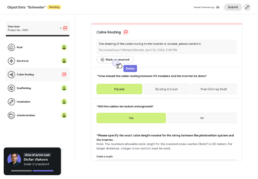


Solution Details
- Section-based comments
- Traceable Activity History
- Detailed email notifications
- Automated task ownership switch
Deprioritized Direction: While best-in-class task management tools offer robust commenting and threading features, implementing a comparable solution was not justifiable in terms of resources, since a simpler approach was deemed good enough.

Insights from 5 User Interviews
The hypothesis didn’t hold true
- The „single lock“ concept proved insufficient. Because the system allows edits to the entire form during a revision, reviewers lose confidence in the integrity of approved sections, forcing a full-form audit for every minor update.
New Learnings
- Allow controlled edits to approved sections: In rare but valid cases (e.g. a customer changes their mind), users must be able to unlock and update previously approved sections.
- Make last minute changes unmissable: Changes often happen just days before installation, so email notifications must stand out to avoid delays or overlooked updates.
Pre-Refinement
- Ideally, the system would have automatically highlighted changes to save reviewers and submitters time. However, due to the complexity of the data—ranging from image uploads to specialized notes—building an automated diff-tool was out of scope for the initial launch.


Solution Details
- Section locks. Limit edits to relevant parts only
- Urgent unlocks. Allow critical last-minute changes
- Loud email alerts making updates impossible to miss
Release Note
One Source of Truth for Technical Feedback
Hey everyone! To help you turn documentation into customer offers faster, we’ve moved project discussions out of scattered emails and directly into the Object Data Form.
What’s New
- Feedback in Context: Review technical notes alongside your data entries. No more cross-referencing emails—the full project story is now in one view.
- Clear Ownership: Automated email notifications and status badges show exactly who has the next step. You and the experts stay aligned without manual follow-ups.
- Reliable Audit: A central log tracks every comment and change, giving you a clear audit trail for every submission.
A special thank you to everyone who participated in our user interviews. Your feedback helped us build this exactly the way you need it!
Post-Launch
120Days
Improved Key Metrics Our solution reduced Submission-To-Approval time by -3 work days
Results
(Successfully) Cut Project Approval Delays
Number Of Feedback Cycles
Baseline: 2,17
New: 1,83
-18,5% Cycles

Submission-To-Approval-Time
Baseline: 7,23
New: 4,27
-2,96 Workdays
Findings & Implications With centralized tracking in place, data revealed photo documentation as the key approval bottleneck. We released two targeted features shortly after to bring it further down!

Photo Tips
Unclear photo standards slowed reviews. Clear photo tips now guide new users upfront, reducing errors and review time.

In-App-Photo-Editor
Users relied on tools like MS Paint to mark images. We added a built-in photo editor for non-destructive, convenient edits.

Together,We Delivered
Teamwork at its best. From strategy to delivery, everyone brought their A-game. Grateful to have been part of a team that delivered with energy and followed through with impact.


Testimonies

Product Lead
I had the absolute pleasure of working with Oliver as a Lead UX Product Designer. Oliver is incredibly proactive – he takes ownership and adds value at every stage of the design process, from user interviews to prototype testing and preparing development tickets. What makes Oliver truly special is his deep understanding of user-centered product development. He’s always thoughtful about balancing effort versus impact, making sure we deliver the most value to users. He independently created and maintained a high-quality, consistent design language for our product that was outstanding.Beyond his reliability and design expertise, Oliver is a fantastic communicator and team player who connects brilliantly with colleagues, clients, and users alike. On a personal note, he’s such an interesting and genuinely nice person to work with!

Key User
Working with Oliver was a real pleasure. He not only has an impressive technical understanding, but above all a keen sense of what users really need. His solutions were well thought-out, practical and have noticeably improved my day-to-day work. I particularly appreciate how reliable, open and customer-orientated he was – always with the aim of creating real added value. Working with him was not only productive, but also very pleasant on a personal level. That’s how you want support and development – competent, committed and at eye level.
